.
GUERNICA WORLD EDITIONS 91
.
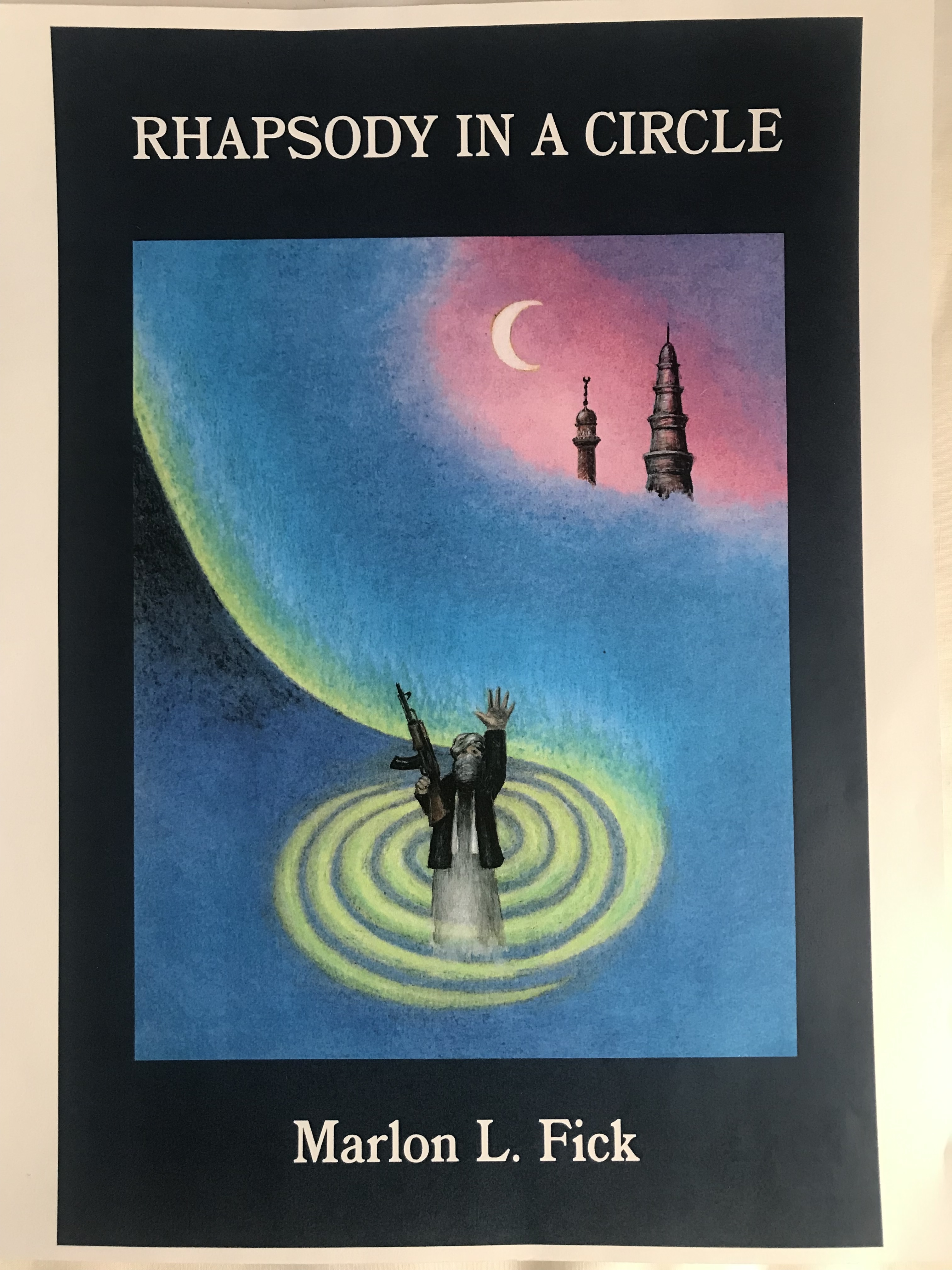
RHAPSODY IN A CIRCLE.
MARLON L. FICK
.
for
my mother, Joyce,
who convinced me to tell this story as if it were fictional, saying that “otherwise no one will believe it”
and for
my wife, Paquita.
.
.
… and thus disclosed the innocent Stevie, seated very good and quiet at a deal table, drawing circles, circles, circles; innumerable circles, concentric, eccentric, a coruscating whirl of circles that by their tangled multitude of repeated curves, uniformity of form, and confusion of intersecting lines suggested a rendering of cosmic chaos, the symbolism of a mad art attempting the inconceivable.
—from Joseph Conrad’s The Secret Agent
Characters
.
.
.
Bolivar Collins (Aka Francisco Barranca, Aka Robert Segovia)
.
In Mexico
Teodesia Segovia Collins (wife of Bolivar Collins)
Karli Collins (daughter of Bolivar Collins and Teodesia) Paco Segovia (son of Bolivar and Teodesia)
Father Sebastián (a young Mexican priest)
Wayne Williams (Aka Robin Ward; American financier with Wall Street Industrial Bank)
Eduardo Aguilar (head of Zeta Drug Cartel) Martha Aguilar (wife of Eduardo Aguilar)
José Luis López (employee of Eduardo Aguilar)
Carmelita (Carmen) Vaghina (Aka Isa Aramara Barranca; employee of Eduardo Aguilar)
.
In Nicaragua
Captain Tomás (also Colonel Tomás, Aka Professor Martinez Saracho; Nicaragua Deputy Director of National Security)
Professor Espejo (associate of Professor Martinez Saracho)
.
In Pakistan
Sahib (a Servant)
Nadia Siddiqui (graduate teaching assistant & unknown employer) Farooq (Head of the Commission, Pakistan Department of Education) The Chancellor (head of the women’s university)
VC (Vice Chancellor of the women’s university) Hasam (Director of International Affairs)
The Retired General, Kahn (board member, women’s university) Mohammed Al Dost (prominent Imam in Islamabad)
Samina (graduate student)
Humaira Kahn No. 1 (graduate student) Humaira Kahn No. 2 (graduate student)
Hina Shahid (graduate student) Serein Asad (graduate student) Sidra Kahn (graduate student) Zaib Sughra (graduate student) Rafia (graduate Student)
Simba Shah (student) Tabina Bari (student)
Mustaf Asad (sex slave merchant and drug merchant in Islamabad) Hasan Jalil (an Afghani refugee boy, age 8)
Ayesha Jalil (formerly Hasan Jalil)
Mohammed Jinah (merchant, Chaklala Market) Nasir (friend of Mohammed Jinah)
Altaf (friend of Mohammed Jinah) Ahmed (brother of Mohammed Jinah)
The Captain (chief of Francisco Barranca’s bodyguards) The Inquisitor
The Knifer
The Knifer’s Assistant (employee of Mustaf Asad) A Geology Professor
Anoosh (owner of a book store in Sadr Market, Rawalpindi)
Tahmina Zara (Professor of Spanish, Islamabad International University) Uncle Jinah (uncle of Mohammed Jinah, Abbotabad)
Fatima Abbas (employer unknown, citizenship unknown) Masood (boyfriend of Fatima Abbas)
Professor Q or Professor Qadir (candidate for professor at the women’s university) Michael Kilduff (United Nations pilot)
Tatiana Puchnecheva (with the United Nations Human Rights Watch) Mahmood (rug merchant)
.
Not-So-Fictional Personages Prince Charles and Camilla, Duchess of Cornwall Hillary Clinton (United States Senator)
Benazir Bhutto (presidential candidate, Pakistan) Daniel Ortega (President of Nicaragua)
Fidel Castro (President of Cuba)
General Parvez Musharraf (President of Pakistan)
.
Chapter 1
.Rawalpindi, January 2007
.
Dawn’s call to prayer woke a curious flock of scavenger kites that rose and circled a smoldering heap of rubbish beside Sadr Market. A high window gradually turned from dark to grey, like the hue of an old black and white photograph, and thin limbs of a Jerusalem Thorn tree leaned heavily against the filmy glass.
With his head still muzzy, Francisco Barranca could not remember his dream. Upon waking, he could not recall his recent past, nor could his attenuated body remember what it should have felt—now it was battered and splotched in purple and blue with open, malicious and infected sores. Memory is something like a bird that flies inside a bird, and Barranca’s memory bird had broken wings. He wanted to move, to sit up in the frowsty bed, but this proved arduous. His fevers had returned, too—fevers that climbed perilously high a week earlier in Mumbai. This was not Mumbai. Not Queen Victoria’s Gateway. And the only gateway was a single inscrutable door that was shut and locked from the outside. The hapless events of the past few days had altered everything, and now he was back in beleaguered Pakistan where a nearby mosque broadcast blaringly the call to prayer from the minaret through a bullhorn in a tortured, electronically distorted foreign language, though he knew the words very well. They were not calling the bloody infidel to prayer; they were, however, rousing the imperious guards from sleep.
Am I who I say I am? kept running through his mind. I am only a teacher … I do not know anything about … Upon waking, Barranca had learned to rehearse, to get into his character. His feigned identity as Barranca had become so much a part of him that he could lose himself behind the veils. If he had not mastered this ability, whoever he was would have ceased to exist. He did not speak his thoughts out loud. One of them might hear.
A candle still burned. Its flicker caught a small bronze statue of Parvati, consort of Shiva, and cast her shadow against the wall.
.
The shadow danced gracefully—her arms and hips came to life in a world of shadows. She was more real to Barranca than what awaited him. He embraced her shadow with his eyes and swayed back and forth with his memories … oh my Teodesia … A broken necklace of tears rolled off his cheek when he tried to remember her face. He had taken a photograph from his wallet dozens of times, but it was not Teodesia, it was a fictional wife with a made-up name, “Isa Aramara,” and the photo was Carmelita, really. Whatever her name was, she—Carmelita—was also beautiful. Their names swam around in him. Teodesia, his wife. Carmelita, an acquaintance, and, like him, a prisoner, but on the other side of the world. Isa Aramara, just random words, one of the veils, like reality, a shade, not a solid, but a shade that traverses dust.
Barranca had grown tired of the incessant questions—Where is she, your wife? Why is she dark like us? Why isn’t she here in Pakistan? Do you have children? Some responded to the picture with shock: “You married a blackie?” The question disgusted him, but he had pretended not to notice their racism, or their assumption that to be a white man you must be a racist: “You’re white! Americans can’t marry blackies! Americans are all racists!” Teodesia was also dark, darker than many of them, and more beautiful than most, but they were commenting on Carmelita, who was actually from Brazil and whose name was not Isa. “Did you know,” Barranca once said, “that the first known racial slur occurs in the Sanskrit language, probably from Old Persian, the word barnish, from which we derive the English word varnish, although the word then referred simultaneously to your color and your caste?”
It was January of the year Barranca would turn forty-seven. The hair around his temples had turned grey, but the rest was the same pile of disheveled reddish blond as before. His face had turned permanently dim and serious, with the gaze of a ghost. Forty-six is not “old,” but this life, the wars and what went with them, had turned him into a very old man who frets about the humiliations of aging. He had been away from home, forced to be away from home, for five years. Those pains that the mind inflict on the body tried to seep through his physical wounds. His right ear was stoppered with dry blood, but his left ear heard the call to prayer, in Arabic, “Divine Arabic,” not in Urdu. Now
.
he associated the call with violence—God is great. There is no God but God. It was a tautology, a circular statement in which the supplicant was trapped as surely as he was a prisoner in a house surrounded by guards and high walls.
One of the guards is Shi’ite. Tonight is the night of Ashura and one of the guards will be away, leaving just the other to guard me. Barranca’s mind began searching frantically. He trembled from weakness. If they beat him again today, he may not have enough strength left, but he couldn’t afford the thought. His eyes searched the pale green room and the high grey window’s photograph of Jerusalem Thorns for anything he could use as a tool, a weapon. They would hear the glass shatter— broken glass would not help.
Lackadaisical and witless, the guards did not consider this broken down man to be very dangerous. He could have, for example, used his little statue of Parvati, but it was slim and no taller than the length of a hand. Striking out with Parvati would only incur their anger, and chances were great that a guard could squeeze the trigger finger on his sawed-off 12-gauge faster than Barranca could raise his arm. They had left him with a small bag of possessions: Parvati, some clothes and books, his cigarettes and matches. What could he do? Light a match and set them on fire? They removed his razor and his mirror—better to not see himself or what he’d become. They left a pencil stub which he could sharpen on the coarse, gritty wall, but it wasn’t long enough to stick in a man’s throat. No pen. And it is not true, the saying that “the pen is mightier than the sword,” or it depended upon whose pen was doing the slaying. Maybe, he thought, he could recite bad poetry to them and they would suddenly find themselves in hell. None of these feeble options for striking out would work, so he continued to dwell on a possible course of action. Then that very day, the day preceding the night of Ashura, an opportunity presented itself. When the guards let him wander around the yard inside the compound, he spied a heap of trash, and in it, a lead pipe, which he quickly hid under his achkan, and later, under his mattress.
He had heard one of the guards talking outside the door. He was telling the other guard their orders. The conversation was in Urdu.
.
.
یک ہلگرام ےسا مہ لک ۔ےتکس ےد ںیہن یسناھپ ںیم ردص ںاہی ےسا مہ
یک ےنناج ہی مہ ےلہپ ۔ےہ شہاوخ یک ہمرتحم ہی ۔ےگ ںیئاج ےل رپ ںویڑاہپ رپ سا نشیزوپ یک ہمرتحم ۔ےہ اہک ایک وک نشیمک ےن سا ہک ںیہ ےترک ششوک
– ںیہ رصحنم رپ سا ںیتمزالم یرامہ اذہل ،ےہ رصحنم
.
“We cannot execute him here in Sadr. Tomorrow we are to take him to the Margalla hills. That is the Ma’am’s wish. First we try again to find out what he has told the Commission. The Ma’am’s position depends on it, so our jobs depend on it—understand?”
Barranca could not see the other man nod through the closed door. Nor could the guards see him listening or know that he understood.
He was thirsty, but they had taken away the clean water along with food. Eventually thirst won over fear of dirty water and he drank from the toilet’s open tank, the lid having been removed for its potential use as a weapon.
The realities of his situation circulated in his mind with the poet, Homer, whose central character found himself in faraway, unhospitable lands among suspicious hosts. If the truth were known to all, this man, Francisco Barranca, was not a spy, not really, although whether one was or wasn’t did not really matter in Pakistan where real and not real bore little relevance. This place had been one of Odysseus’s stops. In Homer’s Odyssey, Odysseus encounters all types: good, bad, ugly, friendly, unfriendly, beautiful, trustworthy, untrustworthy. It was a story about hospitality. When Odysseus’s boat drifted onto the subcontinent’s shores a few thousand years earlier, Odysseus discovered the same habits, the same incessant questions asked of a stranger without the slightest notion of reciprocity. He had to tell his story as many times as asked until the natives could make up their minds whether to invite him to dinner or kill him. Their hospitality had grown famous over the next several thousand years as visitors from all over the world mistook their intense interest in strangers for kindness, their subtle interrogations for “friendly” questions.
Mostly Odysseus told the truth; Barranca did not. He wanted to but couldn’t. And when one is living a fictional, unreal life, one begins to pace in circles like a caged tiger. The natives laid out dishes of Biryani,
.
figs, dates, rice with saffron, tea … They were part of a greater plan to uncover his caliginous purpose; this much was already assumed from the beginning. There were, however, those who were good to him and whose curiosity was spontaneous, not asking the pre-scripted questions one asks to ascertain whether or not someone is a spy.
.
The sun was up now. He sensed that in a brief hour of desultory sleep here and there Teodesia’s face had appeared to him, or he could see her long legs striding back to the house from the market in their home in Jlalpan in central Mexico, and he could hear her call out his real name, “Bolivar!” He believed he might still be able to dream her wondrous face, but he also feared that he could no longer remember the faces of their children, utterly without guile, as he breathed in the chilling vapor of loneliness.
The memory loss was not only from typhoid fever, or the beatings, or food and sleep deprivation and dehydration. One of the Taliban’s bombs had taken the greatest part of his memory. His mind simply threw up a wall. He was aware, the very next day, that he could not picture his son or daughter, or even his long-gone mother and father. Somehow events like these erase one’s personal life and leave only general knowledge. Paradoxically, he could remember books. His memory of written words was etched onto a sequestered tablet in a deep recess hidden inside his brain, there forever, as intractable as the presence in the absence of a wound. Words from books could come to him as easily as singing comes to a bird. And he could discuss any book endlessly with the book simply lying on his desk in front of the classroom, citing even its page numbers without having to stop and look, a feat that impressed some people and frightened others. But the rest of him was washed away, as if his memory had leached out of him right after the explosion. Now his personal memory was shards of shrapnel and broken glass. It had become the human viscera that the authorities washed into the canal with fire hoses. He was holding a small arm in one hand and another small arm, both from different small bodies, as he gazed through the smoke. One of the arms he tried to reattach to a little girl who was on fire. He laid the arms on the ground and tried to snuff out the fire with his bare hands. But it was
.
no use because she was already dead. Logic was telling him that neither of the arms belonged to her, so he continued to look for their owners. That’s when he became aware of a faint muffle of warped sound, sirens or screams, or the mournful cries of whales deep in the ocean, and the wet iron smell of blood and saffron and sulfur and cloves from the vendor’s spiced meat kabobs.
Thirsty, he drank the dirty water from the toilet tank. Canal water that was drawn from the fetid, unfiltered river of Rawalpindi.
After morning prayers, the door opened and the two men grabbed him and dragged him into an adjoining room where they kept plastic on the floor. They sat him down in a chair and taped his wrists behind him. They taped his chest to the back of the chair and his legs to the seat of the chair. I am no man—it was a line from Homer, Odysseus had proudly claimed his name was “no man” to the Cyclops. The line was running through Barranca’s mind like a sutra or a holy chant to ward away evil.
The inquisitor came in. He was a clean-shaven man in his twenties sporting a thin brown Oxford tie against a clean white shirt, and he was sedulous in his task. The guards stepped back as he began.
“Now, my friend …”
“I am not your friend,” Barranca said.
“Forgive me. It is a custom here. Hospitality. You are our guest.
Now, my friend, we have some questions.” “They are the same questions.”
“But today you will have new or better answers. You say your name is Francisco Barranca. You are from the United States? What exactly is your business here?”
“You hired me to evaluate the curricula and advise. In addition, you wish me to teach, so that is what I do. For this you receive millions from the Commission and you skim. I found out and that is why I’m sitting in this chair, and when they catch you, you will be the one in the chair or hanging from a rope … or is it with your head in a basket?” “Yes, this is what you have reported. I believe the consequences of your
lie will come back to you. Still, what I would like to know is who you have implicated in your fairy tale? You see, you may have hurt the innocent in your zeal. So you will tell me the names you put in that report.”
.
“I’m sure you don’t need me for that.”
“No names? Ah, you wish us to beat them out of you.” “I will be dead soon. What does it matter?”
“Let us put aside this … what do you call it … ‘foreplay’—a word from decadent American English. We have a tip that you are here to assassinate someone, someone very important to Pakistan, and this little game that you play with the Commission is merely a diversion.”
Francisco Barranca knew the real jailer, the one giving the orders, not the young man in front of him. It was neither the school’s Chancellor— the “Ma’am” he’d overheard them say—nor the Higher Education Commission. As long as he breathed, the school he worked for—where he kept his real identity covered—collected great sums of money. For them, he was more valuable alive. But who was the double inside the school or the Commission? There was a leak somewhere. A lot more than a few million dollars a year was enough motive to end these past few years of play-acting. The real jailer was Wayne Williams. Williams, the “Financier,” Williams, the shadow—or whatever he was. On the other side of the world, Williams was rolling the dice for hundreds of lives. Or he was circumnavigating the globe in the deepest and most dangerous currents of the underworld. Only when death finally came to Barranca, would he journey to such depths with Odysseus to speak to the seer, Tiresias, and tasting the blood of ghosts, know the truth. But Barranca was already in Hell—it was a place he had come to believe was very real. There is a hell and no heaven. Let the beating begin again.
Maybe they have Teodesia. Maybe her being alive was a false message. Maybe they have already killed her. I’ve said too much. Who is this inquisitor, really?
“If you do not cooperate, what should we do? Should we give you to the Taliban or to the ISI?”
“Your question assumes you are neither. Interesting.”
Motioning to the guards, the inquisitor ordered, “Cut him loose and bring him some tea and rhoti.”
“Sir!”
One of the guards cut Barranca free and moved a table to within reach while the other guard went for the tea and flat bread. The inquisitor continued …
.
“You are not from the United States. You are an Anglo, yet a Mexican national with a degree from Princeton, yes?”
“Whatever you say.”
“I confess I believe you are perfect for the job, but what sort of job is it, really?”
“My job is teaching your idiot children to think themselves out of the parochial bubble you made for them. And what for? Because Musharraf is worried that the Paki rupee is weaker than the Indian rupee.”
“Is that what you think? Everything is about money to you Westerners. You all think you are so important. To me, you are no one. You are a plague in my country that must be purged with fire. You are a scavenger.”
“I confess as much. Why not simply let me go home?”
“Go? Go free? Commit hideous crimes and just walk away? No, my friend. You will pay. You will pay for the deaths of many children. You will pay for polluting their minds. You will pay for raping Nadia!” “Nadia?” Barranca was only surprised because he had not heard her
name in so long.
“Oh, you are surprised that I know about that? Oh, I know about all of your victims. And you would have gone on raping young girls if I had not stopped you. And do you know that we will castrate you for this before we kill you?”
“You know full well that I rejected Nadia. I refused all of her advances. You know this. What is the point of trying to convince me of your elaborate ruse if you mean to kill me anyway?”
“No, my friend, here in Pakistan, we value the truth. Truth is part of our devotion to Allah. And we are not without evidence. We have your violation on tape.”
He paused …
“You are married, yes?” “Yes.”
“Her name is Isa? You are married even though you are a homo?”
Barranca’s face twisted into a laugh which opened a scab covering his split lip. It was too absurd. The fantasy. Maybe Plato was right to banish poets as liars from the Republic—at least the bad poets should be
.
banished. I, Barranca, “raped” Nadia and dozens of others, and now I’m a homosexual, only Barranca is not my name and my job in Pakistan is that of a simple courier, a small cog in a large machine of banks and armies and cartels.
Every day the inquisitor asked the same questions, each time throwing in a new question or two, and in so doing he had revealed more to Barranca than vice versa. Now, by mid-morning, Teodesia’s face had come fully into view, welling up from deep inside his broken body. He could see her calling his name. That was what kept him alive for four years. That was his purpose—to keep Teodesia and the children safe. Follow orders and they lived. The inquisitor interrupted his thoughts.
“Tell me again about these old wounds. They are war wounds?”
Barranca only had to tell the truth. Nothing about the old leg and chest wounds contradicted his cover.
“From Nicaragua. I served in the Nicaraguan army. That was more than twenty years ago.”
“And after the war, you went to Harvard.” “Princeton.”
“Right, Princeton.”
There was a man named Francisco Barranca at Princeton in the 1990s, and he had immigrated there from Nicaragua, but the true account had placed him on the side of the Contras, not the Sandinistas. Barranca wondered if the inquisitor knew this.
“What were you doing at that bookstore all those Sundays?”
“Is this a trick question? I get books. You have the reports. You know how many cigarettes I smoke in a day, how many spoons of sugar I have in my morning coffee—all very relevant to your national security. Your sycophant Nadia reported every word of every class and followed me like a pestering little dog. You know I eat lentils and rohti for lunch and drink tea-white on the verandah by the bottlebrush tree where sometimes a green parrot sits on a branch and squawks. In the afternoon I grade papers or write my reports for Dr. Farooq. At five o’clock in the afternoon, my bodyguards arrive to take me to one of the so-called safe houses, shuffling me around from Pindi to Islamabad to Peshawar. Sometimes, in the middle of the night, one of your gunmen
.
knocks on the door and whisks me off to yet another safe house, without so much as a why or a wherefore—no ‘imminent threat,’ just ‘Let’s go.’ On Fridays, I leave with the guards for visits to the other universities to evaluate their curricula and weed out their frauds. But they keep their fake professors because they’re highborn or some general’s kid, so the truth is meaningless. Even your questions are part of a mirage.”
The interrogation was over. It was the last one and Barranca knew it. His only edge was that they didn’t seem to know he understood Urdu or that he had heard the kill order. In the afternoon, one of the guards brought him food, the second time in a day, after a week without food or clean water. A last supper was the extent of their sense of mercy. It consisted of rhoti, some rice with cloves, and tea-white. He ate alone wondering if Teodesia and Karlita, his daughter, were alive. He wondered if they thought he had abandoned them. He wondered if his son was still angry with the world and everything in it. He forgot much of the past, but he remembered the Black Suburban and wondered if anyone in their little pueblo, Jlalpan, had seen him being kidnapped. In the morning they would take him to the Margalla Hills and make it look like a Taliban killing. The bullhorns blew the call for evening prayers. The Shi’ite guard would be leaving now to observe the Night of Ashura. Barranca slipped the bar under his achkan and carefully grasped the handrail down the curved steps to the main room. The lone guard was facing east, genuflecting on his rug, his shotgun laying parallel beside him. He was lost in ritual motions and prayers. Barranca thought of a moment in Shakespeare’s Hamlet when Hamlet hesitates to slay the usurper King, his uncle, fearing that his soul might fly to heaven. But Barranca did not believe in heaven. He didn’t hesitate. He struck the man on the head with the iron pipe with such a force that the blow made a sound like an egg when it drops on the floor. Then he took the keys to the compound. Now he retrieved his small pack. He did not know if the guard was dead or unconscious, but he hobbled past him on his bad leg without looking, unlocked the metal door to the compound unaware of exactly where he was, and stepped out into the street. It was Sadr Market, the night of Ashura. He walked a few steps into the street. He was just in time to witness a most terrifying scene of holiness and blood.
Chapter 2
.Sinaloa, July 2002
.
Eduardo Aguilar was fat and quiet, like a Buddha except in all other aspects, since no serenity or harmony dwelled beneath the surface of his calm. He sat in a big leather chair with a small glass of gold tequila in one hand and a Ducado cigarette burning in the other. When he did speak, he was boorishly devoid of any decorum. Bolivar Collins could see a row of Starlings perching outside on a phone line. They looked like musical notes—all of them the same notes on only one line. The American was talking, a man named Wayne Williams.
“Mr. Collins, I represent a financial company, maybe you have heard of us … ‘Wall Street Industrial Bank.’ Sr. Aguilar oversees our office here in Sinaloa.”
Bolivar Collins did not know he was in Sinaloa. His home was in the state of Querétaro, a long way from Sinaloa. Aguilar’s men had covered his head with a black sack. He did not know Williams or Aguilar, either. He did not know why he had been brought here.
“We’ve watched you,” Williams said. “Your career—very impressive—you have a set of skills that could be useful to us. It’s what? A symptom of your autism—though mild I’m told—that makes you something like a savant? You can see patterns where others can’t, right?” “I don’t know what you’re talking about. I’d like to go home. Thank
you all the same.”
“Yet, unlike other autistics, you’ve learned how to analyze and interpret social cues? I find you quite interesting, Mr. Collins.”
“I am of no use to you. I’d like to go home.”
“If I may … I’d like to lay it out for you, just the same. You see, I know all about your activities in Nicaragua. Do you know that fighting for the other team is ‘treason’? I can have you extradited like that.” He snapped his fingers to punctuate “that”. “Or you can come to work for us. Stand trial for treason or … oh, Mr. Collins, please, as you consider your options, remember that Mr. Aguilar would regret any harm that might be done to your family.”
.
Bolivar Collins felt nauseous. He had repressed the horrors of the past, memories that existed now as if in old books we closed and placed on the shelf beyond reach. These years now were peaceful. Jlalpan was small. Teodesia was a fine companion, wife, and mother of his children. She had welcomed their return to what had been her girlhood home, especially after the trauma she knew in Nicaragua. Neither of them ever spoke of those days or of the world’s cruelty. Typically, days began early. He drank a cup of coffee with Teodesia at six o’clock, had some buttered toast and yogurt. When he was fully awake he would say “Good Morning, darling.” And Teodesia would say, “Buenas días, mi amor.” And Collins would go to his office to write until lunch. Teodesia would call for him around one o’clock and their lunches were a leisurely two hours, longer when the kids were not in school. On occasions, Collins skipped work and took Teodesia and their two children to Tequisquiapan or the city of Querétaro, seldom as far as Mexico City, except on one occasion to show Karli and Paco the museums. After lunch, Collins wrote a little more, ending somewhere in the middle of a thought, somewhere where he could easily pick up the following day. Meanwhile, Teodesia had her garden and the fruit trees, her magazines, gossip with her amigas. Apart from school, Karli had a dozen projects ranging from writing books, like her father, to piano lessons, to chemistry experiments, the likes of which had never been reproduced, but she had very long and involved explanations for every new combination, invention, work of art, astronomical discovery, etc. Teodesia called her their “Baby da Vincita.” Paco, on the other hand, was inward and brooding and contumacious. He spent his free time in the tree house his father helped him build. Up there, Paco reigned supreme, conceiving all manner of plots and schemes to destroy his rapacious enemies, who were usually the kids from school who called him a “dirty gringo.” And because Paco was more private, his mother and father found it increasingly difficult to understand him and know him. Still, even with the occasional quarrels with Paco—between Paco and Teodesia, mainly—their lives were as smooth as twilight greeting the night, a way of life that could not have been farther from the worlds of these men, Aguilar and Williams.
.
“With your ability with languages,” Williams said, “your under- standing of cultures, you will be an asset. It would be a shame to waste your talents.”
“Excuse me, Mr. …” “Williams. Wayne Williams.”
“Excuse me, Mr. Williams, all this seems like a lot of drama for
… what did you call it? … a job offer. Perhaps you could describe the job you would have me do. I ask this because I think I recognize your associate from the news. Mr. Aguilar, isn’t it?”
Eduardo Aguilar sat very quietly with his tequila and his cigarettes. He listened but remained expressionless. He was a man of power and reach. His pictures in the paper, his business in banking and casinos, even his trafficking, were simple matters of well-known fact. A dozen bodies hung from the international bridge spanning Nuevo Leon, Mexico, and Laredo, Texas on his orders. Why should he care if Collins “recognized” him? The only man who ever impressed Eduardo Aguilar was himself. Perhaps, as a child, his father had impressed him, once upon a time. His father was a hard man and a heavy drinker. Sometimes, halfway through a bottle he would begin to weep and squeeze his little boy, muttering some story little “Eddie” (or, “Eduardito”) had already heard about the evils of the intoxication of women, very bad women, and their snake-like deceptive qualities. But since the age of thirteen, Sr. Eduardo had stopped being impressed by anyone. He rose through the ranks of the cartel, first a courier and a packer, later a soldier, then a bodyguard—all the while gaining the trust of high-ranking cartel men whom he later killed.
Now Sr. Eduardo Aguilar lived in luxury in Sinaloa. He had guards. He had other guards to guard his guards. He had a home with more rooms than God Himself—“In my Father’s home, there are many rooms. I will go to prepare one for you! said Jesucristo,” Aguilar loved to say, followed by chuckles, throat clearing, and a wheezing cough. Maybe he had fewer servants than God, but he did have servants, and the best tequilas, a grand piano that he did not play, a large library filled with leather bound books which he did not read, and expensive paintings by very famous painters whom he’d never heard of—one of them a “Rembrandt.” And although he was approaching his seventies,
.
he also had women, a dozen or so, who lived there, albeit against their will. All of them were beautiful, and all of them had the simple job of looking and acting beautiful to impress whomever Aguilar wanted impressed. He had heard of Muslims, men who were rumored to keep many wives, and despite his allegiance to the One and Only Holy Apostolic Roman Church, he could not help but admire them, whoever they were. He had also been told of the Shogun War Lords of Japan who kept many geishas for amusement. And he had heard of the lazy Sultans and their libidinous harems, but he did not know the difference between a Shogun and a Sultan. It did not matter. These Muslims wanted to do business with him, and their keeping of many wives was sufficient logic, or affinity, to expand his business, which is why Williams had come down from New York.
.
Mr. Williams of New York had already proven to be a reliable silent partner, and even though Aguilar trusted no one, not even Williams, in just one year their deals had netted Aguilar over 340 million dollars and had increased the strength of his growing army incrementally, making Aguilar stronger than the Federales and the Mexican Army combined. Now Aguilar was ready to explore new markets in the Middle East, and Williams was the man. By now, he was convinced that Williams was not a DEA agent, but Williams was vague about his other affiliations and clients. After a year of business, Aguilar let Williams have limited Power of Attorney on Aguilar’s behalf in both Mexico and the United States.
Aguilar was uneducated and foolish, but not about his business. He could read people easier than a newspaper. If a man even looked the wrong way in a negotiation, Aguilar would kill him. About Williams, Aguilar knew that he kept things hidden. He knew that his motives did not always have to do with money—the money was simply a means to various ends. Aguilar knew in a day, upon meeting him, that he was not simply a banker because Williams knew things that bankers did not know or care about: the various kinds of flower teas in China, the way the Day of the Dead reminded him of ancestor worship in Africa, and the kill radius of an RPG. All Aguilar had to do was let him talk and Williams would size himself up all by himself—Aguilar noted that Williams could also speak like some of the senators he owned. He
.
could speak and say nothing, and this amused Aguilar. He could tell from his build that he was ex-military, but the sort who still kept a gun close. While Williams talked percentages and pay schedules, Aguilar noted his serious blue-eyed gaze and military posture. He must be a very successful man like myself, he thought, possibly more successful. On one occasion the two men were having a glass of tequila beside the pool, and when Williams answered the telephone, he suddenly switched to some utterly demonic tongue that Aguilar did not recognize. “What is that? Chinese or Arab?”
“Oh, no Señor, that language was Pashto.”
“I never heard of it,” Aguilar said. Aguilar told one of his guards to get his globe from the library and then he made Williams show him where people speak “Pashto.”
“It is,” Williams said, “one of the languages of these areas … Here in Pakistan and Afghanistan. Urdu and Punjabi are also spoken in this area.”
On another occasion the two men had been drinking rather a lot, celebrating a grand success in business. Williams, slurring a little, asked Aguilar if he could fight one of the guards—for fun. Aguilar thought about this as well as any man could in a fog of alcohol. “Are you sure you want to do that? You might get hurt.”
Williams insisted. “I really feel like having a go at that one, you know, keep myself in shape.”
Aguilar thought … Let him have Sebastián. “Sebastián! Come here!” he yelled.
Sebastián Marco came quickly. “Don Aguilar, sir?”
“Let Mr. Williams have a go at you, will you?” “Certainly, Don Aguilar.”
The two men squared off on a patch of green between the pool and a row of palm trees, and before Don Aguilar could take another sip of his tequila or tap the ash of his cigarette and commence to watch, Sebastián was laid out on the well-manicured lawn, temporarily unconscious.
The women who were sunning themselves by the pool saw this and were impressed. Even a buzzard was impressed—it left its perch
.
on a saguaro cactus and circled once high over the unconscious man, Sebastián Marco. The feral animal that lives inside of us smells blood and becomes aroused. Sometime, hours after midnight, one of them, Carmelita Vaghina, risked her life going on tip-toes surreptitiously down a long hall to Williams’s room to be with him.
Chapter 3
.Rawalpindi, January 2007
.
On the night of Ashura, a long procession of faithful Shi’ite men was stirring the dust on a street and marching in Francisco Barranca’s direction, making a great noise with the clashing of swords and screams of devotion. The moon was full and flashed across the silver blades that they swung in the air and flailed themselves with. All of them had cut through their clothes and deep into their backs, self-flagellating with the swords. Francisco had seen a similar spectacle years earlier in Mexico City, the faithful crawling up the avenue of Guadalupe on pilgrimage to the Basilica, edging their way on bloody knees. Such behavior, he thought, was disgusting. He stepped into the shadow of an alley and watched. The men bore deep cuts and their blood dripped into the street. They must have numbered five or six hundred. By the next day, the rotting blood would cover the streets of Sadr Market and the air would fill up with black flies and draw the scavenger kites into circles overhead.
Now Francisco had his bearings. He was not far from old man Mahmood’s rug shop. He didn’t trust Mahmood still after five years, but he had no other choice. He had to get off the street before someone spotted him. The rug shop had been one of the first clandestine stops Francisco made under orders from Williams and Aguilar. There he passed along a ciphered code, which in turn arranged a shipment from the poppy fields of Afghanistan to the port of Karachi where it would be loaded on a ship bound for Rotterdam, and there transferred to a ship bound for Miami. The same route in reverse was used to bring new weapons from the United States to the Taliban. Williams had men everywhere, working on the inside. Francisco began to understand that Williams was even more powerful than Aguilar. Aguilar had dozens of trucks rolling across the US-Mexico border, but Williams had carte blanche in several countries, though his name appeared nowhere on any invoice or customs’ form. In return for these shipments, the jihadists received both money and all manner of military toys. And they received
.
their goods cheaply due to competition in the marketplace. US sellers had to compete with suppliers in Dubai, Beijing, Tehran, and Moscow
… It was a complex operation and no one, with the exception of Williams himself, knew every link in the chain.
.
Many of the older jihadists enjoyed the same trade routes from back when they called themselves the Mujahidin. Even then, some of their weapons came from traders behind enemy lines. It was so commonplace that the word Kalashnikov was part of a small child’s burgeoning vocabulary.
The first time Francisco slipped away, eluding his Pakistani employer, The Higher Education Commission, to meet the old man Mahmood, the bearded old fellow invited him to sit down and have a cup of tea, so Francisco knew that he was not among the strictest observers of Islamic laws, laws that forbid communing with infidels. So, Francisco sipped on his tea while the old man gently probed him with questions. Three young men were present, sitting in a semicircle and eating lentils with lamb, sopping up the sauce with rhoti. Francisco noticed that one of the young men was remarkably handsome, almost felicific, with very long eyelashes. None of these young men took much interest in the old man Mahmood or the American until Francisco (the American) unwittingly violated a taboo by asking if the young men would be joining them for tea. The pretty one stared back at Francisco with frightening coldness. “They do not speak English,” the old man said, “or Urdu, for that matter.” The dulcet one was the most vociferous. He chastised his fellows for not dressing “thusly” in the proper manner of the Prophet, motioning at his own properly donned baggy white pants that were tied of with strings at his ankles just over his sandals—his fellows feigned listening, like squat limpets clinging to his words while they crouched over their lentils. Nothing, no matter how trivial, would escape the eye of Allah, and for their degree of observance, they could expect rewards from Allah reciprocally. Conversely, any deviance from His path will incur his wrath a thousandfold, unless these deficiencies were rectified—penance for an unclean thought; penance unless you enter the toilet with your right foot and exit the toilet with your left foot; if you see a dog or a puppy, you must punt it as far as possible for a heavenly field goal; send an enemy of Allah to Hell; never say you
.
have killed your enemy, but rather proclaim that he or she is now in Hell. “Today, 85 Shi’as are in Hell—all praise to Allah,” one of them said. Allah must be credited for all things, no matter how small, and no matter if it be for good or evil. “Typhoid and cholera have spread through the stinking refugee camps where the cowards live and now more than three hundred are in Hell—praise be to Allah,” one said. “Praise Allah,” the other two said in chorus.
Francisco was not sure what penalty awaited them if they were to have accepted his offer to join them for tea.
Finally, the time came to address the business at hand. Mahmood leaned over and asked Francisco quietly for the information he needed.
“The Mayflower,” Francisco said.
“Fine. Fine. That concludes our business.”
“No, I’m afraid not. I must have this put on a note and wrapped in a tapestry and mailed to this address. Otherwise, I will be in trouble.”
“I see. It is not a problem. Give me the address.”
Francisco handed it to him. The old man Mahmood put on a pair of spectacles and looked at an address to a place in Mexico City that neither he nor Francisco knew.
“Fine. Fine. Pick out a tapestry. The children make them because their fingers are small and very nimble. They do excellent work, yes?”
Francisco pointed to one of the tapestries on the wall, one that was filled with tiny red and yellow finches.
“Fine,” Mahmood said, “it will be going out tomorrow by DHL. Very fast. Five days. Ok?”