.
Artist Statement by Paquita
I paint in order to chronicle my experience and to capture the passing of time and the changing light. There are moments that reveal themselves to me as a feeling—joy, gentleness, despondency, etc…
.

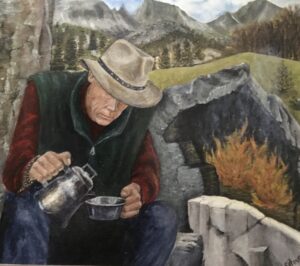
Francisca Esteve Barranca (Paquita) painted “First Coffee” (Acrylic on canvas, 16” x 20”) when we were courting, about fifteen years ago. The painting is based on a backpacking trip we took to the Wind River Range of Wyoming. There’s War Bonnet Peak in the background, which marks the continental divide. In the foreground, I am pouring coffee while trout is cooking on the fire. There was trout for breakfast and dinner—we fished to avoid carrying too many freeze-dried meals in our backpacks. As with most of her paintings, she chronicles a moment we’ve shared on our journey. Typical of her work is that she is always there, too, bearing witness. What she chooses to witness about is how any moment her eye lands on becomes illuminated. Note the way the old coffee pot reflects the gold and silver of the light even through the charring from the fire. Narrated by Marlon L. Fick
.

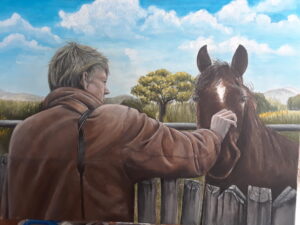
In 2020, Francisca (Paquita) and I traveled to Truchas, New Mexico, where I attended a writer’s workshop. She caught this moment with me and a horse. An art dealer, looking over several of her paintings exclaimed that her paintings could not be commercial as long as she continued to use the same model (i.e., me)—no one knows who I am. But Paquita isn’t interested in doing commercial art, rather, she would prefer to capture something of authentic value. I would hasten to add though, that one of her paintings, a portrait of the 46th US President, now owned by the Ellen Noel Art Museum, was purchased for $7,000 dollars. She is not opposed to selling the works, but this isn’t her primary objective. In every work she undertakes, she is keenly focused on catching the light. Narrated by Marlon L. Fick
.

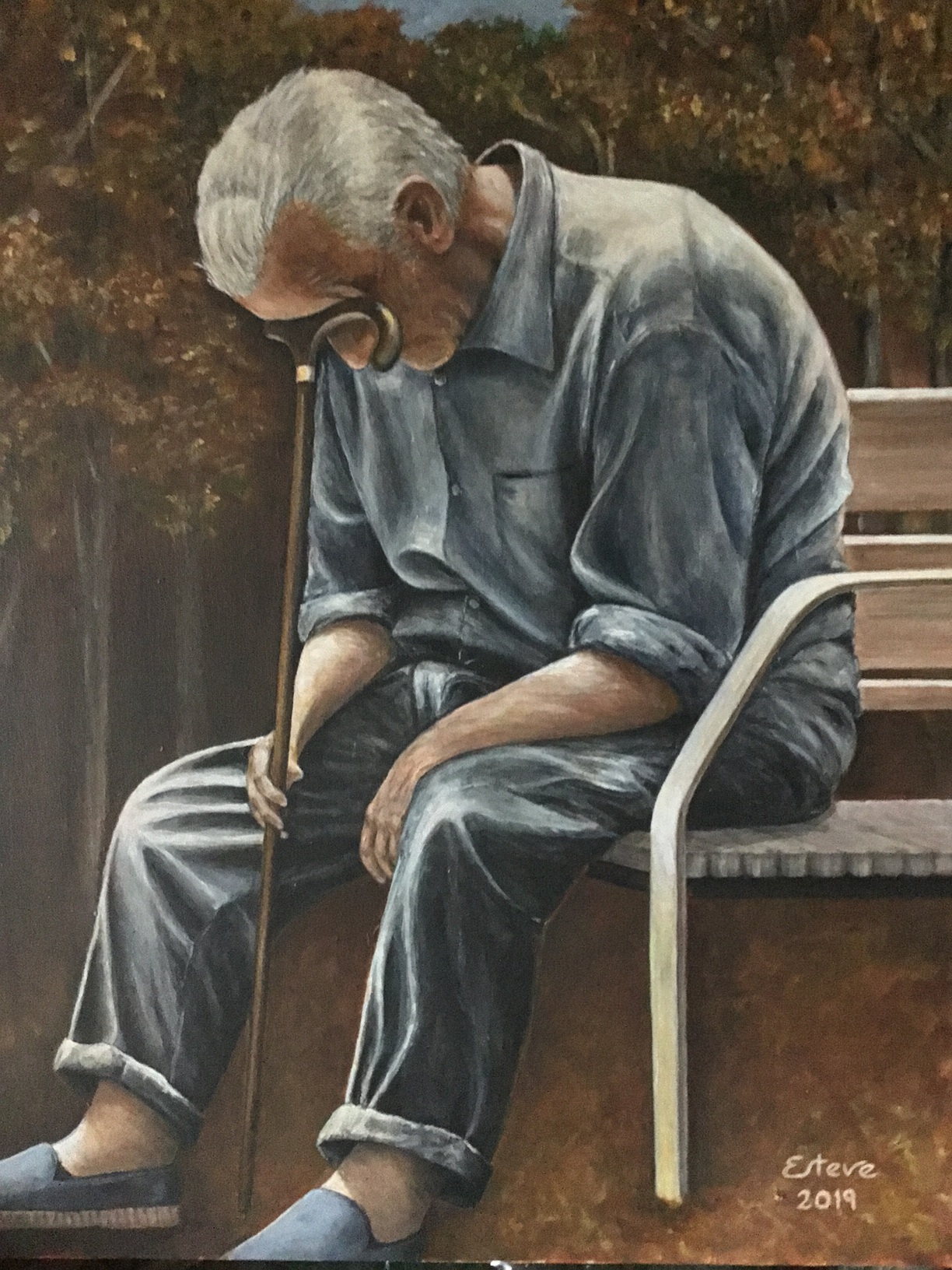
While on a trip to Spain in 2018, I was translating Catalan poetry at my favorite little café in the Plaza de Pi, in Barcelona, and waiting for Paquita (the co-translator) to join me there when I saw this old fellow, surrounded by people and buildings and noise. I snapped his picture with my Nikon. Later Paquita used him as her subject in “Fall Dreams.” Somehow, by magic, she managed to get inside his consciousness just by transforming the landscape around him from summer in a city to autumn in the country. From his white hair down to his swollen ankles, his being expresses our need to rest or to find a moment of peace, particularly important to those of us who are feeling our age. Narrated by Marlon L. Fick
.
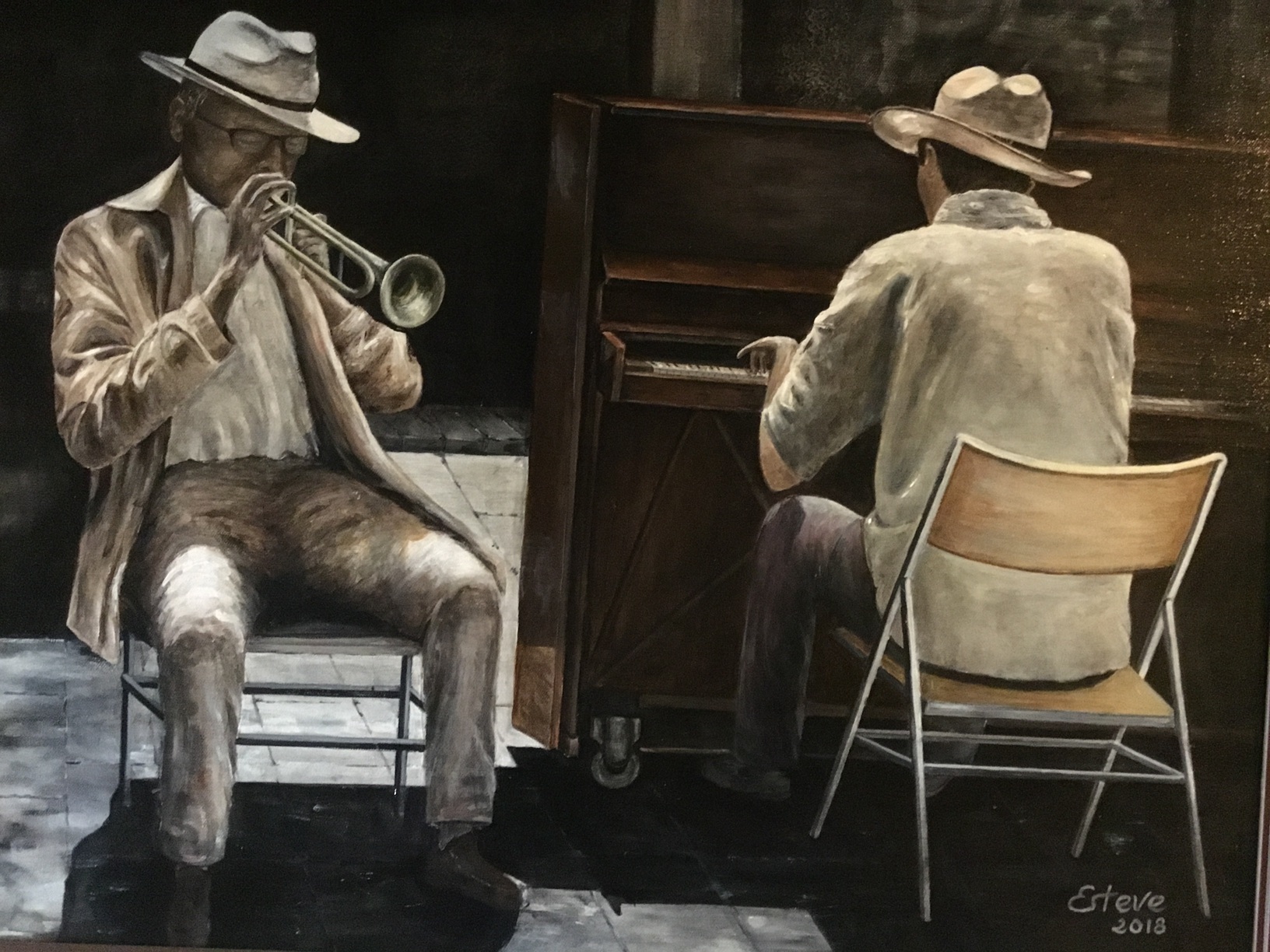
Turning again to the same city, Barcelona, Paquita once again found her subject matter on a day we were out walking on the Rambla. It is in this painting where I find her attention to light and shadow most prevalent. If I recall, I was tired and rather hot, wanting only to find a cool place to sit and drink something cold. Paquita wanted only to snap a dozen or so pictures, already conscious that this would be subject matter. As with all trips, there was a lot of walking and looking. This may have been the same day we walked to her old art school, Escuela Massana, a short distance from the Rambla. Now, when I look at this painting, I remember how hot I was, and possibly grumpy, but I also hear the music they’re playing. The thing about her art is that someone will always take something from it because it has been so freely offered.
Narrated by Marlon L. Fick
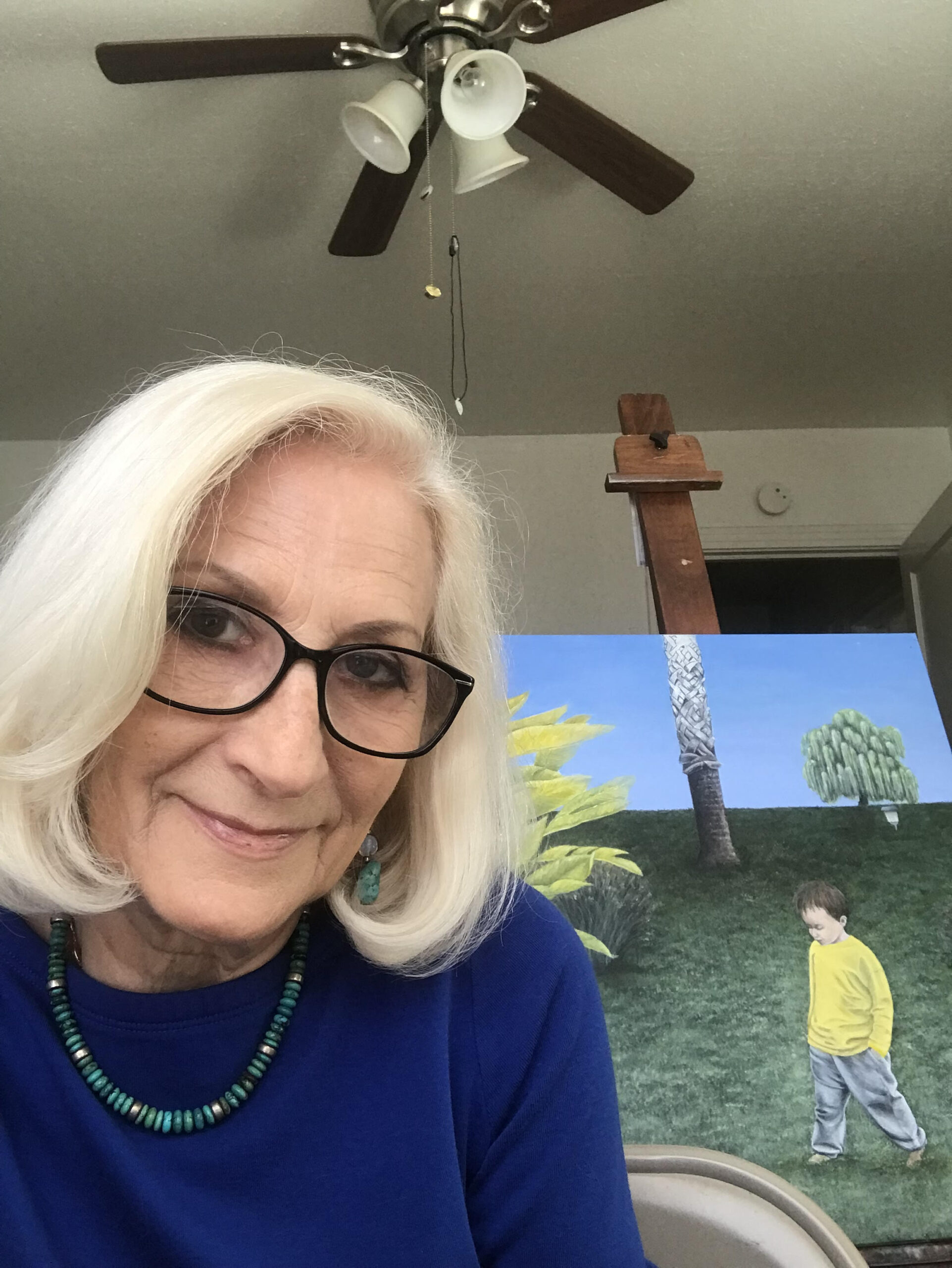
Francisca (Paquita) Esteve was born in 1947 in Valencia and grew up in Barcelona. She trained at Escuela Massana, Art and Design Center in Barcelona, and became an interior designer and a painter, eventually emigrating to Mexico in 1984. She and her husband, the writer and composer Marlon L. Fick, lived in China for a while, and then came to the United States in 2014. After that they moved to Texas in 2018 and currently reside there. One of her paintings hangs in the Ellen Noël Museum.