

The Man Who Fed on Moonlight and Whispered with the Stars
Where turquoise waters and soft white sand meet the endless blue sky, some see a paradise for rent. But for others the mixture of lingering shadows of palm trees and the sea breeze carries a faded scent of old Hispañola, where centuries ago, before the arrival of Colón, the Taínos lived in this unspoiled paradise.
Just a short stroll from the shoreline, at the Barcelo Bávaro Palace, tables overflow with extravagant buffets tailored to satisfy semi-sophisticated palates. Bartenders at poolside bars hustle to meet the relentless demand for cold drinks, as waves of tourists arrive by the minute, drawn by the promise of an eternal happy hour. Yet if you don’t speak un poco español, be prepared to wait—perhaps endlessly—in the ever-growing coco-loco lines.
This was the old Barcelo Bávaro—a time when a slow-moving trolley carried sun-kissed guests between the five hotels: the Beach, the Casino, the Golf, the Garden, and the Palace. Back then, between lunch and dinner, lobsters sizzled on the grill by the shore, often served with a generous splash of mamajuana poured by a smiling hand.
Nights bled into mornings as guests stumbled out from la discoteca, their footsteps heavy with Cuba libre and rhythm. At sunrise, they were greeted by Haitian waiters—some of whom had taught them to dance the night before. With easy smiles and steady trays, they offered hangover shots like tiny blessings before the breakfast buffet –It was all part of the ritual, the rhythm of a place that knew how to take care of its wanderers—one that could satisfy even the thirstiest Russian souls.
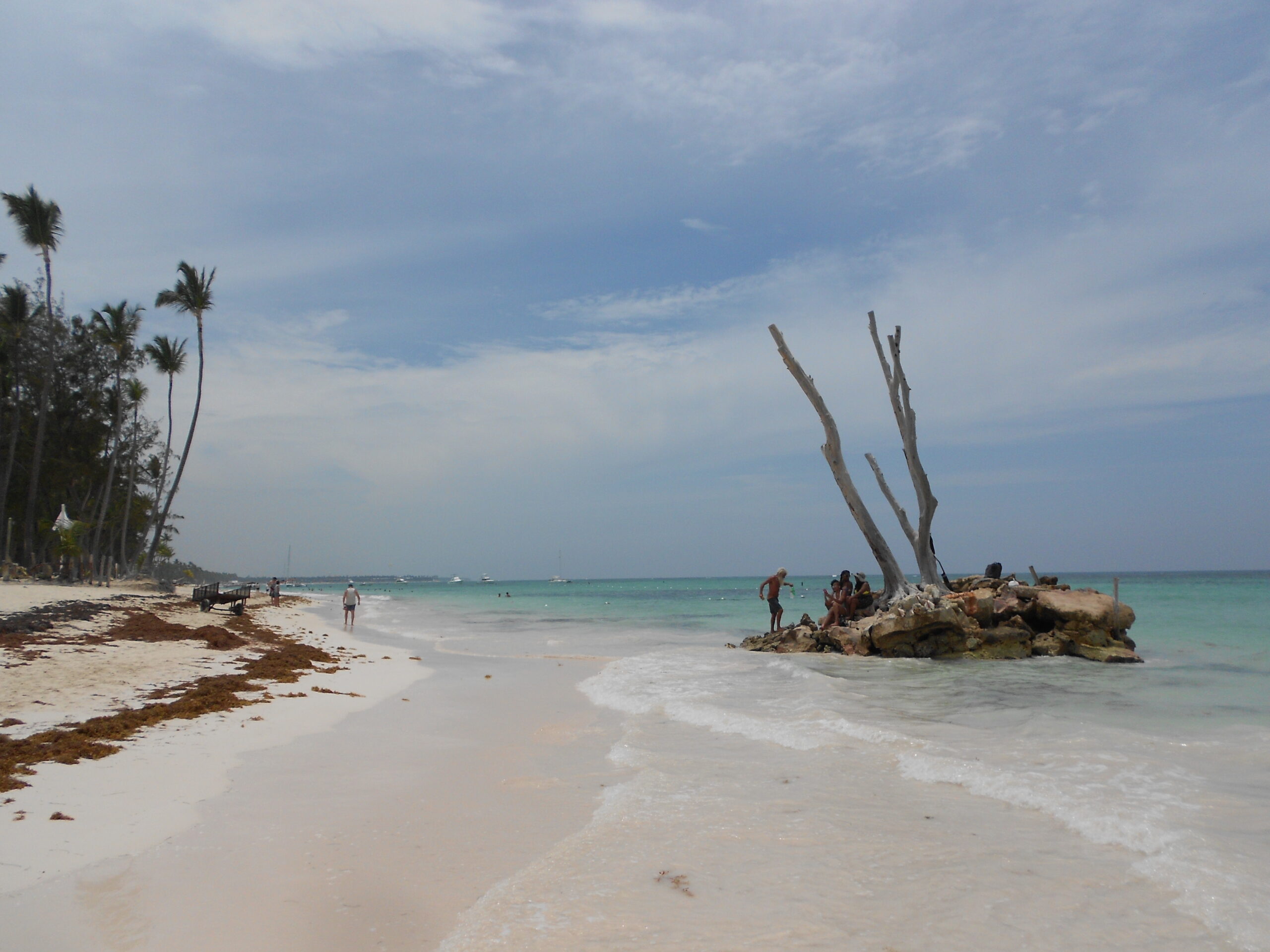
Just a short walk down from Barcelo Bávaro Beach, something unexpected waited to unfold. Knee-deep in the shallows, on a partially submerged patch of stone—more a mangrove-wrapped rock than a true tidal island—a dead tree stretched its limbs skyward, casting patchy shade over a barefoot man in his sixties. His long silver beard glinted in the sun, and his hair, tangled and sun-bleached, spilled down to his elbows.
He sat beneath the branches with a weathered guitar, strumming softly, eyes lifted toward the fading afternoon light—like someone completely at ease in the world, as if this moment, this sunlight, was enough.
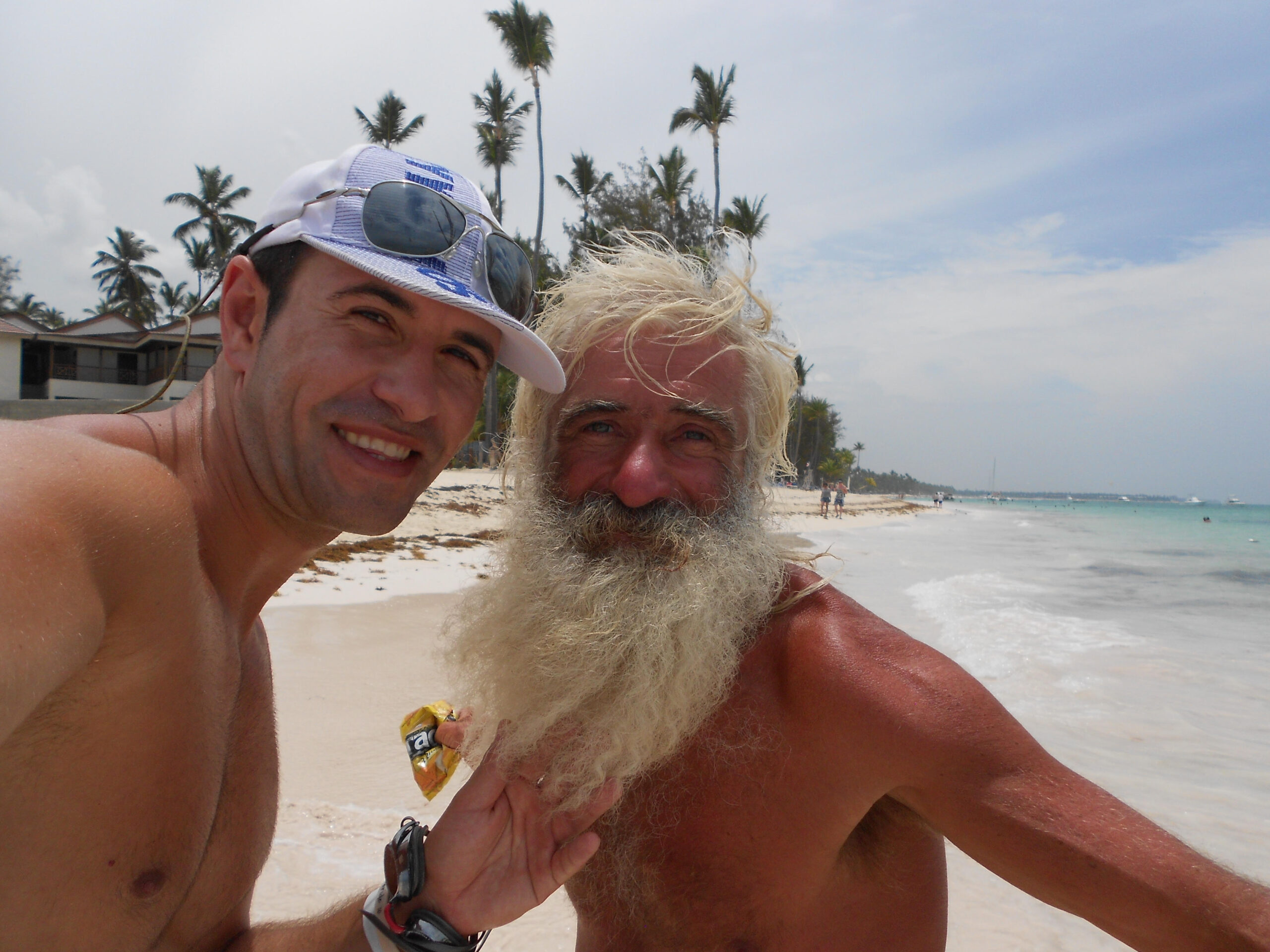
Drawn by his striking presence and warm, welcoming smile, we found ourselves walking toward him almost without thinking. When our eyes finally met, it felt less like an introduction and more like a quiet invitation.
He looked up with a calm, quiet dignity and told us his name was Sasha. Despite the worn clothing and bare feet, there was nothing ordinary about him. He carried himself with a kind of effortless grace—calm, composed, almost regal in his stillness.
Though English was not his language of choice—nor his strength—we quickly found common ground between our native Polish and his Ukrainian. Words came slowly, haltingly, but the meaning passed between us with surprising ease. More was shared through tone, gesture, and intent than grammar ever could manage.
Sasha—or Oleksandr Krynychny, as we would later learn—was the man’s full name. In his worn backpack, wrapped in a faded plastic bag, he carried his most treasured possessions: a handful of documents and some yellowed newspapers.
When Sasha discovered we were from Poland, his eyes brightened with excitement. Without hesitation, he hurried back to his tidal island to fetch a small, weathered notebook. To our amazement, its pages were filled with handwritten notes in more than twenty languages—messages left by visitors from different parts of the globe. Inside were delicate drawings, brief poems, tiny songs, and warm wishes addressed to the man with the long white beard.
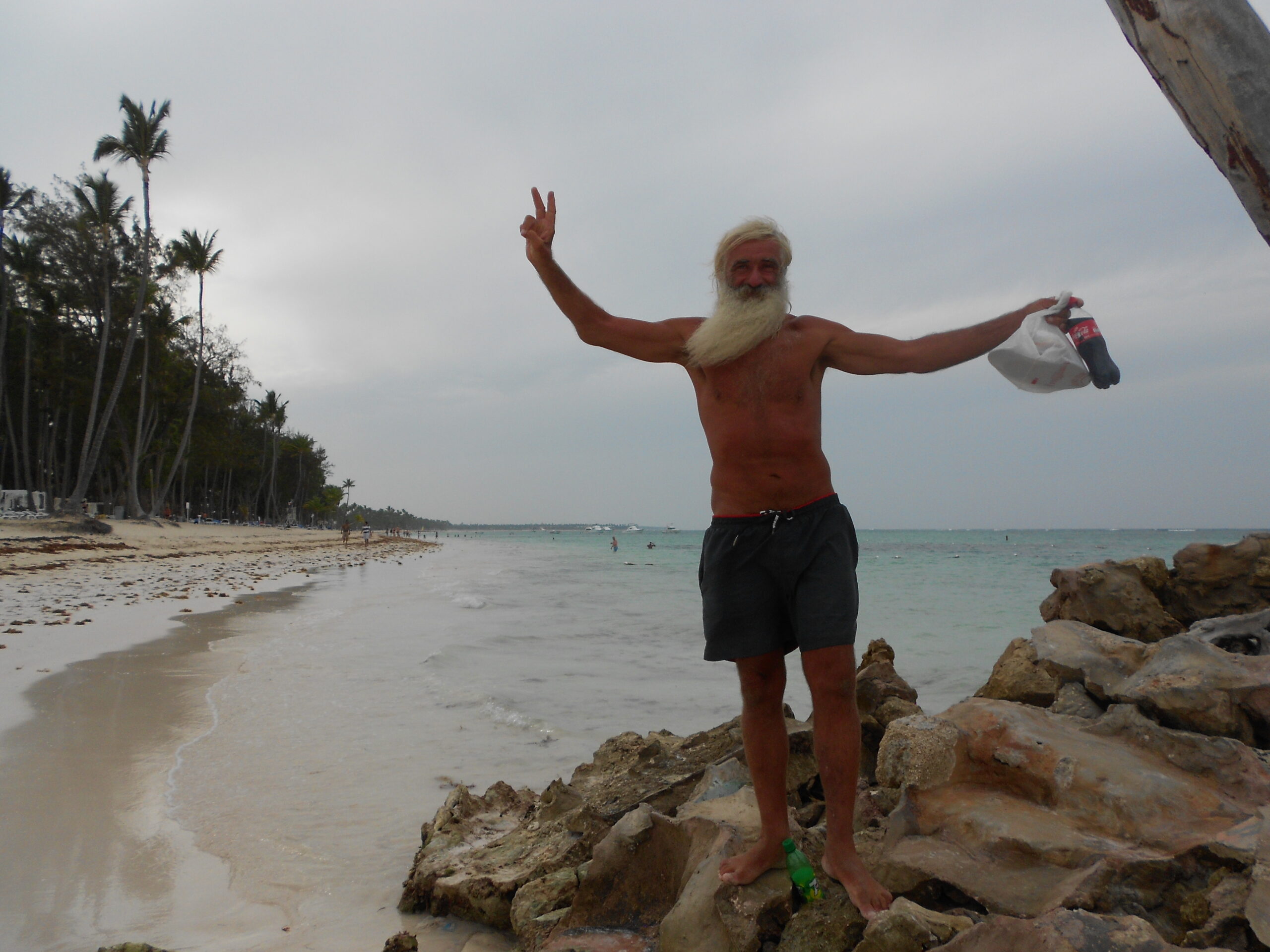
As we grew more comfortable with one another, I offered Sasha some American dollars and mentioned I had clothes I could give him. But he gently refused, saying, “Ni, diakuyu, ne potribno.” No, thank you. It’s not necessary.
To our surprise, he elaborated. He didn’t need money or clothes—he had everything he needed beneath his feet: the sea, the sand, the warmth of the sun by day, the moonlight by night, and a tropical paradise to call home.
What he asked for instead was simple—a hamburger and a Coke.
As the tropical heat gave way to a cool ocean breeze, we set out for an evening stroll along the beach—this time carrying two hamburgers and a large Coke for Sasha. The white-bearded man received us with radiant gratitude. In Ukrainian, he invited us back to his little island and carefully hung the food on a low branch of the dead tree, as if placing it before an altar.
Then he reached for his guitar, tuning it slowly, and began to strum a melody of an old Polish folk song—chanting in his own native tongue. Before playing, he handed me his notebook and a pen, gently asking us to leave him a travel note.
I opened it to a random page. There, in faded ink, someone had written:
“Our best wishes to the bearded man who feeds off the Moon and greets everyone with a warm smile.”
When Sasha finished the song, he brushed his long white hair from his face and fixed his gaze on the sun as its last light chased the horizon. Moved by the moment—and by that strange, poetic phrase—I finally asked him about the remark.
Sasha seemed genuinely pleased by our question. With a warm smile, he began with a side story, “When I was in Warsaw, Poland, I was on strike, holding an SOS sign. I had to wash myself in the river or a fountain.” He paused, then added, “I was trying to get Polish citizenship because my mother was Polish.”
Seeing our growing curiosity, he continued: “I even met President Kwaśniewski, but they refused my papers because my father was from Ukraine.” It became clear he was seeking more than answers—he was looking for listeners, perhaps even friends.
As he shared more, we learned he grew up poor and studied agriculture—a “profession from God,” as his father used to say. Sasha believed the KGB had intercepted his father returning from the Second World War, accused him of being a spy, and that he never saw him again.
His stories touched on police and government corruption too. Sasha had come to the Dominican Republic in the summer of 2013, with the help of a Ukrainian developer who arranged his flight. He strongly believed it would be easier to get a US visa from here than from Ukraine.
To our surprise, we furthermore learned that Sasha loved to dwell on life and death, and was a great admirer of American literature. He particularly quoted William Faulkner:
“Our tragedy today is a general and universal physical fear… There are no longer problems of the spirit. There is only the question: When will I be blown up?”
This quote made me ponder on the modern world issues —shaped by the trauma of two World Wars and the looming shadow of nuclear annihilation—these spiritual concerns have been overshadowed by a more immediate, visceral fear, our survival. The question is no longer “What is the meaning of my life?” but “Will I survive tomorrow?” This “universal physical fear” dulls our spiritual imagination. We become consumed with threat and danger, and lose touch with what it means to be fully, inwardly human.
That evening, all these heavy reflections poured out, as if we were the only ears willing to listen to Sasha.
At last, the silver-haired man returned to my earlier question—the one that had lingered in the air since I first read the inscription in his notebook: What does it mean to feed off the Moon and the Sun?
Sasha paused for a moment, as if weighing whether to speak plainly or poetically. Then, with a soft smile and eyes reflecting the dying light of day, he said:
“The sun feeds the body, yes—but more than that, the moon feeds the soul. Sun’s energy isn’t just heat or light. It carries something older than science can explain. Something that sinks into your bones if you let it. You learn to be still… to absorb it, like plants do.”
He lifted his face slightly, feeling the last warm rays on his skin.“But the moon,” he added, his voice lowering, “the moon is different. It doesn’t feed you—it stirs you. It whispers. It reminds you of dreams you thought you’d forgotten. At night, under her light, you don’t feel hunger in the same way, the moon fills you. The moon helps to remembers other kinds of longing… things that have no name.”
For a moment, none of us spoke. The waves rolled in soft and rhythmic, like they were listening too.
“The sun fills you with life,” he said, “but the moon shows you why you’re alive.” He turned toward the horizon, where the last blush of sunset gave way to the deepening blue of night. The stars had begun to scatter overhead, and the moon—bright and pale—rose slowly behind the curve of a cloud.
“Between the two,””he said finally, “there’s no hunger left in me. Because during the day I feed of the sun and during the night I eat the moon”
Some things may have been lost in translation—or perhaps it was just mamajuana speaking. Maybe the white-bearded man was no more than a trick of the light, a fever dream conjured by salt air and sunstroke when we laid and contemplated in the shades of old Hipañola. Or maybe—just maybe—he’s still out there.
Sitting beneath that dead tree, when the tides rise and the moon casts long shadows over Hispaniola.
Waiting,
Singing,
Feeding off the moonlight,
Whispering to the stars,
Collecting notes and telling stories of time long passed.
And when the sun returns, perhaps he vanishes into its glare—along with the stories of those who come here chasing something more: adventure, meaning, or a secret only the sea remembers.
Lukasz D. Pawelek , (Ph.D. Wayne State University) is an Assistant Professor of Spanish and German in the Department of Humanities at University of South Carolina Beaufort. His research interests encompass U.S. Latinx and diasporic literature, literary representations of nostalgia, collective memory and globalization, and the evolving Latinx identity in the United States; secondary field of interested: Post-Wall Ostalgie memoir and film. Pawelek is a co-founder and co-organizer of the annual Gateway to Interdisciplinary Graduate Studies Conference. He established Polyphony Research Group that engages students in undergraduate research, conference presentations and service in the Latinx Community of Lowcountry.